I first met Andrew in 2019. He is a bit of a celebrity in the brain tumour community (whatever that means). He is also one of the closest people in my life, great individual and irreplaceable friend. He has been through a lot of tough times (like myself) and tries to make the best out of his experience by sharing his knowledge and helping others.
I did a short interview with Andrew, among others, about keto, biggest misconceptions about brain tumours and positive things the diagnosis brought him.
You were diagnosed with a brain tumour in your late twenties, how has it changed you?
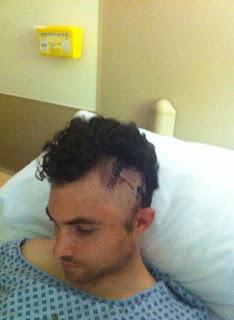
At first it was very difficult because at that age I feel you are reaching your peak and getting settled with who you are as a person and where you’re going in life. I felt super fit and healthy with my best days ahead of me and suddenly I was struck down with a terminal and incurable disease. Life felt so unfair and I was left with horrible symptoms, including epilepsy, which made me feel depressed. I was however, determined to find solutions because there was no way I could live like this. I focused on quality of life and remembered from my background in nutrition that the ketogenic diet could potentially help to manage my symptoms and may even slow down the growth of my tumour. I applied it early on and managed to refine the approach until I developed good control of my symptoms and it appeared to have benefit on my subsequent scans of the tumour area. I have learned so much about myself, about others, and I have a deep appreciation for those who deal with the disease, whether directly or indirectly. I make the most of everything good in my life and my perspective has definitely changed with what I choose to prioritise. Another thing I focus on more now than ever before is to let people in my life know how I feel about them and that they are appreciated. Having any kind of reminder of your mortality usually has this kind of effect I think. Even though I’ve suffered tragedy in my life, there have been opportunities to help others from it, and that kind of human connection brings deeper purpose and meaning to my life.
What is the biggest misconception about brain tumours?
To me the answer to this question has a lot to do with what is unseen. Young people with brain tumours often don’t ‘look’ unwell. There is also some confusion between a ‘brain tumour’ and ‘brain cancer’, as well as the classification, because it’s different to other cancers. Brain tumours are classified by ‘grade’ rather than ‘stage’ and there are a number of different types of brain tumour that all have different characteristics, effects on the patient and predicted survival outcomes.
One major misconception is consistent with reactions about other cancers, that once you’re treated or are in remission, people will assume you’re better now. They don’t realise that with grade 3 and 4 brain tumours, these invariably return at some stage, even many years later sometimes, and are incurable. If you mention this fact, the response will often be that you are too negative, but it’s overwhelmingly the typical scenario. I think acknowledging this can actually be a positive thing if you are then proactive about understanding the disease and what you can potentially do to prevent or at least slow down it’s progression/recurrence. Keeping up to date with the research can be empowering, but the misconception that you can ‘fight’ it like a ‘warrior’ is somewhat naive and unhelpful at times. I’m a positive thinker and an optimist, but also a realist.
Why do you think there is little advancement in research into brain tumours over the past thirty years?
I believe there could be a number of reasons for this. The most obvious thing that springs to mind is that brain tumours are incredibly difficult to treat. Few drugs cross the blood brain barrier at therapeutic doses, and if they do there is a possibility that they could be toxic to the rest of the brain and not just the tumour. It turns out brains are pretty important and quite delicate. We also need to focus more on targeting metabolic defects of these tumours, rather than simply focusing on driver mutations. Thankfully this is beginning to happen now, though it’s been a long time coming.
Another factor is the poor survival rates. Big pharmaceutical companies are unlikely to find drugs that move the needle on these poor statistics, so they are less inclined to pour money into it. As I mentioned, it’s a real challenge to even get drugs across the blood brain barrier, and even then you have to try and prove it works without significant toxicity to healthy brain tissue. Much easier to focus on a more common, more treatable cancer like breast cancer. If all else fails with that in the earlier stages, at least you can remove a breast, you can’t remove a brain.
The third aspect of this is that even though brain tumours are so lethal, it isn’t seen as an attractive cancer to talk about. It’s bleak and depressing because the brain houses the essence of what makes us human. Even though other cancers are horrible, when compared to breast or testicular cancer, the gallows humour is more playful. Breasts can be fun and there are many jokes that can be made about testicles. Brain cancer isn’t a ’sexy’ cancer, and those who have lost loved ones from it usually just want to move on. There aren’t big movements behind this disease on a national and global level.
You are a big supporter of the keto diet. What are the biggest benefits and drawbacks of this lifestyle?
For me the biggest benefits of the diet has been for my mental health and to manage brain tumour related epilepsy. At first it was a bit lonely, because not many people understood the diet and clinicians even suggested it might be ‘dangerous’ for me due to unfounded claims about saturated fat and cholesterol being bad. I didn’t receive much support at the time and I could only draw upon my own research. I would say the main drawback is that many social situations revolve around carb laden foods, meaning you can feel a little awkward in those situations. People have often thought I was being fussy or that I was judging what they were eating, when in reality I couldn’t care less. I still enjoy food and though I am passionate about healthy eating, I don’t judge others.
We sometimes get absorbed by the topic of cancer and brain tumours in particular. How do you vent/cope with the heaviness of the topic?
This is a difficult one because I spend so much time focusing on it in work and in life, but I have learned to realise when those moments happen and to be more selfish. You shouldn’t compromise your own health so much, even if it is for the sake of others, because you are no good to anyone if you don’t take time out to recharge and enjoy yourself. The thing I love most is walking in nature, whatever the weather. There is a wealth of research on the mental and physiological benefits of immersing yourself in nature in this way and I treat it like meditation. These long walks also help me to stay in ketosis and lift my mood if I’m feeling miserable, even if I have to force myself to do it. Sometimes if it’s a cold, dark morning in winter, it’s the last thing I want to do, but I ALWAYS feel so much better after doing it. It makes me feel alive, gives me time to reflect, and relieves any tension or worries I carry with me.
Apart from this, I also take time to keep a journal and I like to read. I’m learning to read more non fiction and to learn new skills because these forms of escapism can teach you so much about yourself and you will always have something interesting to show or discuss with others. Human connection is something I really value and I like to feed off positive energy from people with a similar mindset. As a natural empath, I feel in the past I spent too much time with people who were very negative and would drain me of energy. In any healthy relationship, sometimes although its natural to have low moments, it should be about each of you building each other up and it should be balanced. I feel I have that with all my close friends now and that’s invaluable to me. I am grateful for that and I let them know.
What positive things has the brain tumour brought into your life?
This is a common theme, but I certainly learned about who my friends are and who I can really rely on when times get tough. Everyone has stuff going on in there lives, but all we can do is try. I am thankful to those who stuck around and I learned so much over those years about friendships as well as romantic relationships. When I have happy moments now I really take time to take it all in and enjoy it. I make sure to let people know how I feel about them and to make special memories. Sometimes we don’t realise how special these moments are until they’re gone.
I feel as though the biggest positive is that I am more emotionally intelligent. I can empathise with others and I can be more ‘in the moment’. I can also see how much time society wastes when doing things like waiting at a train station glued to screens rather than getting to know new people. I’ve become that annoying guy that talks to random people when doing these things instead of staring at my phone, and although this isn’t always appreciated, I try to be intelligent about who is open to it. If not, I feel as though I’m just wasting time. I want to make the most of my life, especially after losing my Mum to cancer in 2019. She was an incredibly optimistic, positive person and before she died she impressed on me to make the most of time and follow my heart.
That was a difficult time in my life, but the people close to me at the time, especially the person who writes this blog (yes that’s you Anna), picked me up when I was struggling to find meaning in even the simple things in life that previously gave me so much joy. I was reminded about how beautiful life could be and that there was so much light I could shine on those who have experienced dark times like myself. I’m now even more determined to help others, to enjoy my life, and to keep doing what would have made my Mum proud of me.

 Anna's Brainstorm
My other point is related to not having accurate information about your situation.
When people first find out that they have a brain tumour, the information that they receive—from their doctors and from other people online—is overwhelmingly positive. That’s not a bad thing in itself but I think it often leads to bad decisions. I find it heartbreaking when people are told that everything will be fine with their grade 4 glioblastoma and that their treatment will have them right in no time. Who is to tell them otherwise? There’s always someone with a story to tell about how the prognosis is wrong: “My uncle was told he only had six months and he lived until he was 92.” “You’ll be fine. You just have to fight it and have a positive attitude.”
Maybe some people prefer to hear only the most optimistic spin on their situation. That’s their prerogative and I don’t want to take that away from them. Me? I’d rather know the truth as realistically as it can be told. I want to know the possible bad outcomes as well as the possible good outcomes. If a craniotomy is going to give me an extra 10 years, I’ll have the craniotomy. If it gives me an extra few months with a likelihood of severe deficits, I’d rather skip the craniotomy, thanks. If I am not long for this world, I’d rather know so that I can prepare and make arrangements for my family. I don’t want to be told that everything will be ok.
I think too many people have treatment that is actively bad for them because they have a green-shifted understanding of their situation and the probable success of their treatment. It’s sad how many people are shocked that their high-grade tumour recurred (“My doc told me I was cured”). High-grade tumours recur. It’s what they do. I don’t think it’s useful to tell people that they won’t.
LikeLiked by 1 person
I’m glad you found the patience to write your original comments! Very deep! thank you for writing it. I really appreciate your input. And so true what you wrote!
LikeLike
Trying again…
Fantastic interview! Thank you, Anna and Andrew. I agree with everything you say but there are two points that I especially resonate with and I want to amplify your message.
I find it empowering to understand what is happening inside my head and was shocked to learn that so many disagree. On a Facebook forum that Anna and I belong to, the first message that everyone hears is “Whatever you do don’t search for information on the internet.”
The first question that everyone wants to ask is “How long will I live?” and the answers on the internet are bleak and wildly misleading, not least because brain tumours vary so much depending on grade, type and location. I definitely subscribe to the idea that searching for survival statistics on the internet is a terrible idea. Talk to your medical team if you want to know. I actually never asked anyone this question and still don’t know the answer.
However, I want to know everything there is to know about my tumour and my treatment options. For the first few months I spent every evening reading PubMed papers and everything else I could find about low-grade gliomas and how they are treated. I even bought a copy of The Principle of Neural Science (Kandel) and read it cover to cover.
When a new friend on Facebook told me “Whatever you do, don’t look at the internet”, I replied that, actually I find it quite useful. She was horrified.
“It’ll just make you depressed.” (It didn’t).
“You won’t understand it anyway” (I did understand it).
“You should just let your doctors tell you what to do” (I identified two serious (and dangerous) mistakes that my neurosurgeon made).
I completely understand that a lot of people would rather not know and just let their medical team take care of them. Me? I want to know everything. I find it empowering and it helps me ask good questions of my medical team and it also helped me to answer that final, terrible question “It’s up to you. What do you want to do?”
I said a lot more on this topic on my own blog:
I’ll write a separate comment for my other point.
LikeLiked by 1 person
Argh. I just wrote a massive comment that WordPress just ate. I’ll see if I can muster the fortitude to write it again after my coffee.
Short version: Wonderful post, thank you, Anna and Andrew. I agree with everything you have said.
LikeLiked by 1 person
Delated comment sounds very frustrating! Hopefully you will find the strength to write it again! Thanks for reading!!
LikeLike